

Culture and heritage
The sword in Sikhism (Sikhi)
Miri · Piri · Kirpan
Why does a faith built on remembering the Creator, humility and seva honour the sword? In Sikhi the answer is simple: the sword stands for justice and for protecting those who cannot protect themselves. It is never meant for conquest, revenge or aggression.
Miri and Piri: two swords
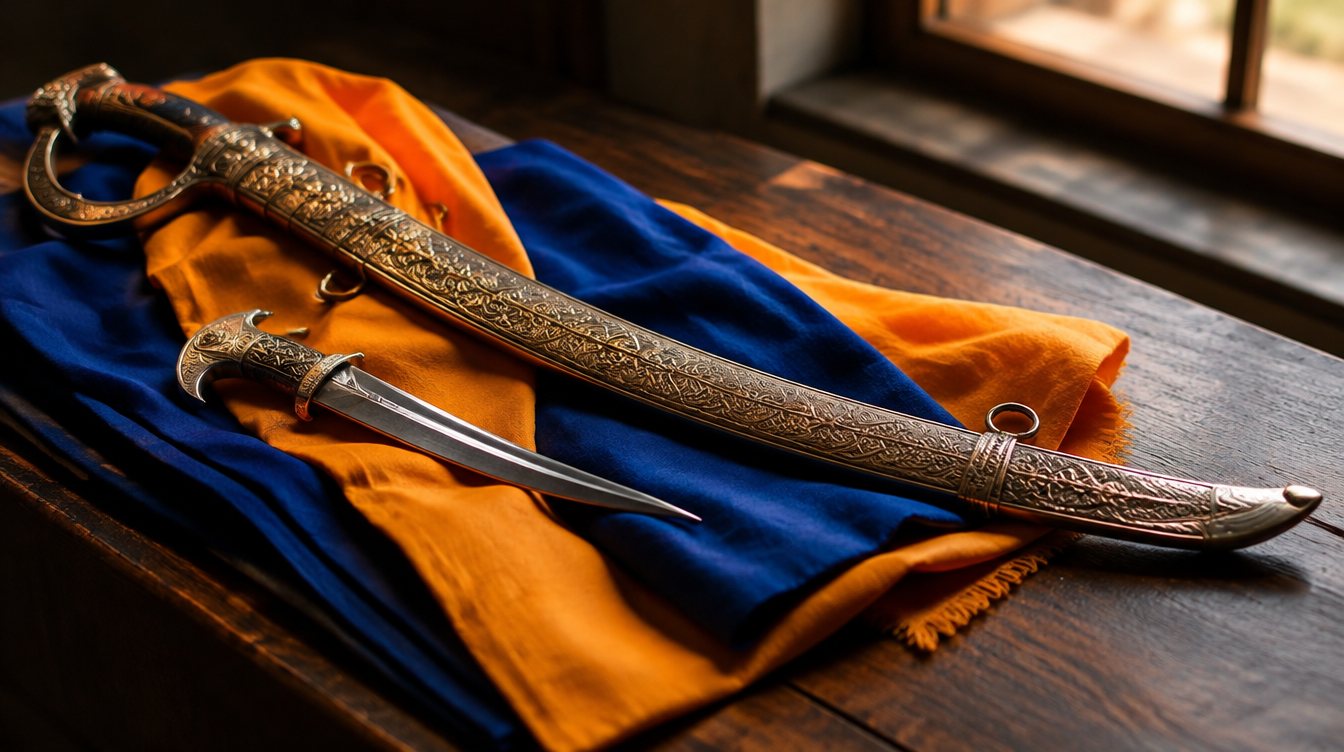
Guru Hargobind Sahib Ji, the sixth Guru, wore two swords. One stood for Piri, spiritual authority, and the other for Miri, worldly authority. Together they taught that a Sikh’s spiritual life and responsibility in the world belong together: devotion without courage is incomplete, and strength without devotion loses its way. Guru Hargobind Sahib Ji also kept a body of armed followers to defend the community against oppression by the Mughal rulers of the time.
The saint-soldier
From this grew the ideal of the sant-sipahi, the saint-soldier: a person who is gentle, humble and devoted, and who also stands up fearlessly for what is right. The saint comes first. The soldier exists only to protect.
Guru Gobind Singh Ji: when the sword is right
Guru Gobind Singh Ji, the tenth Guru, taught that peaceful words and patience should always come first. But when every other way of stopping cruelty and injustice has failed, it is right to take up the sword. Non-violence, he taught, has little meaning in the face of tyrants who prey on the weak, and refusing to stand up to injustice can cause more harm than good.
The conditions are strict. The sword is to be used only in defence, for the protection of the weak and for the good of people, and never for conquest, plunder or revenge. In his writings, Guru Gobind Singh Ji honoured the sword as a power that brings down the wicked and protects the righteous.
The kirpan today
When Guru Gobind Singh Ji created the Khalsa in 1699, the kirpan became one of the five articles of faith that initiated Sikhs keep with them at all times. The word is often explained as joining kirpa, mercy or grace, and aan, honour and dignity.
The kirpan is a religious article, not a weapon carried for harm. It is a constant reminder of a Sikh’s duty to stand for justice, to protect others, and to live with self-respect and courage. In Canada, the Supreme Court recognised in 2006 that a Sikh student may wear a kirpan to school under reasonable conditions, such as keeping it sheathed and secured under clothing.
Independence, self-respect and courage
In Sikhi the sword is a symbol of freedom and self-respect, of a people who will not live in fear and will not let others be bullied. Its message is the same as the rest of the Gurus’ teaching: humility before the Creator, courage before injustice, and care for everyone.
What it means to our club
For the Panjabi Sports and Social Club, the spirit of the saint-soldier means standing up for our neighbours and serving them: donating blood, looking after Meadowgate Park, welcoming newcomers, and showing up when the community needs us.
Stand up and serve
Give an hour to the next clean-up, blood drive or community event.
Volunteer with usThe main principles of Sikhism (Sikhi) · Six basic beliefs of Sikhism (Sikhi) · Saka Panja Sahib · Bhai Jaswant Singh Khalra