

Culture and heritage
Panjab: the land of five rivers
Jhelum · Chenab · Ravi · Beas · Sutlej
Few places on earth carry their story in their name the way Panjab does. Panj means five and aab means water: the land of five rivers. For thousands of years these waters have fed the soil, the songs and the spirit of a people known the world over for their courage, generosity and joy.
Five rivers, one land
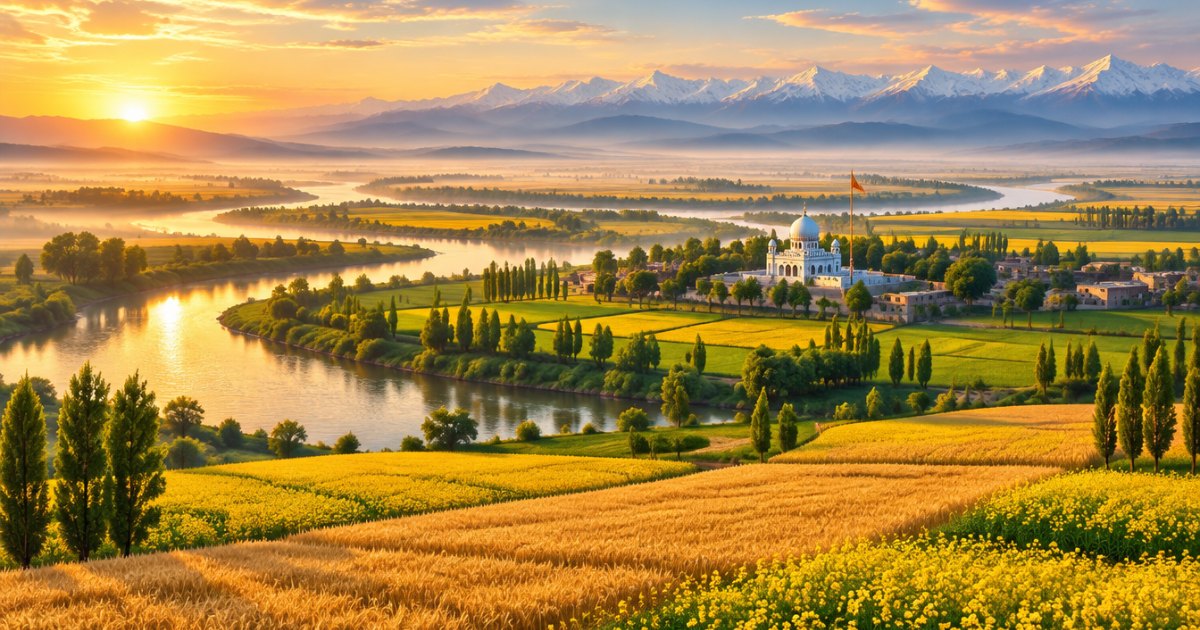
The Jhelum, the Chenab, the Ravi, the Beas and the Sutlej come down from the Himalayas and spread across the plains before joining the mighty Indus. Their waters made Panjab one of the most fertile lands in the world, and shaped the life, work and celebrations of everyone who lived along their banks. Wells, canals and village ponds carried that water to every field, and the rhythm of the rivers, swelling with the monsoon and the melting snows, set the rhythm of the farming year.
The rivers, one by one
The Jhelum, known in ancient times as the Vitasta, flows out of the beautiful Kashmir valley through Srinagar before entering the plains. Its banks have seen kings, armies and pilgrims for thousands of years.
The Chenab, the ancient Chandrabhaga, is the river of Panjab’s great love stories. Folk tradition places the tales of Heer and Ranjha and of Sohni and Mahiwal on its banks, and Panjabi singers still call on the Chenab whenever they sing of longing and devotion.
The Ravi, the ancient Iravati, watered the city of Harappa more than four thousand years ago, and later flowed past the walls of Lahore, the jewel of Panjab.
The Beas, the ancient Vipasha, is remembered as the river where the army of Alexander the Great turned back in 326 BCE, never to cross the river and march further east. It joins the Sutlej at Harike, where a great wetland now welcomes migrating birds every winter.
The Sutlej, the ancient Shatadru, the longest of the five, rises in Tibet and cuts through the Himalayas. The Bhakra Dam on the Sutlej brought water and electricity to millions and helped make modern Panjab bloom.
A cradle of civilization
Panjab’s story is among the oldest in the world. Harappa, one of the great cities of the Indus Valley civilization, stood on the banks of the Ravi more than four thousand years ago, with planned streets, covered drains, granaries and standard weights. Ancient texts sang of this region as a land of rivers, and the great roads through it brought travellers, traders, scholars and armies for centuries. Taxila, near the Panjab plains, was one of the oldest centres of learning in the world. Through every age and every empire, Panjab kept its own spirit: open, resilient and proud.
The birthplace of Sikhi
In 1469, at Talwandi, now Nankana Sahib, Guru Nanak Dev Ji was born. From this soil came a message that still shapes millions of lives: one Creator, the equality of every human being, honest work, sharing with others, and remembering Waheguru. Guru Nanak Dev Ji travelled far and wide, and then settled at Kartarpur on the banks of the Ravi, where he farmed the land and the sangat ate together in the langar.
The ten Gurus built that faith on Panjab’s soil. Guru Angad Dev Ji gave shape to the Gurmukhi script. Guru Amar Das Ji made the langar a place where king and beggar sat side by side. Guru Ram Das Ji founded Amritsar, and Guru Arjan Dev Ji built Sri Harmandir Sahib, open on all four sides to people of every caste and creed. At Anandpur Sahib in 1699, Guru Gobind Singh Ji created the Khalsa. Today Sri Harmandir Sahib, shining on its sarovar, welcomes visitors of every faith to sit together and share langar, day and night.
The same land gave us the Sufi poetry of Baba Farid, whose verses are in Guru Granth Sahib, and later Bulleh Shah and Waris Shah, whose Heer is still sung today.
A rich language and literature
Panjabi is one of the most widely spoken languages in the world, written in Gurmukhi in East Panjab and in Shahmukhi in West Panjab. It is a language made for poetry and song: earthy, warm, witty and full of feeling. From the shabads of Gurbani and the kafis of the Sufi saints to the modern poetry of Amrita Pritam and Shiv Kumar Batalvi, Panjabi literature carries the joys and sorrows of the land. Folk songs, boliyan and tappe are still sung at every wedding, every harvest and every gathering.
A kingdom and a name for bravery
In 1799, Maharaja Ranjit Singh took Lahore and built a strong, united kingdom that stretched from the Sutlej to the Khyber Pass. His court welcomed people of every faith, his ministers and generals came from many communities, and he covered Sri Harmandir Sahib in gold. The Sher-e-Panjab is still remembered with pride.
Panjabis have earned a name for bravery wherever duty called, from the Anglo-Sikh Wars to the battlefields of two World Wars, where Panjabi soldiers served with great honour. The courage of the Sikh soldiers at Saragarhi in 1897 is still told around the world.
The food bowl
Panjab’s fertile plains and hard-working farmers made it famous far and wide as a land of plenty, the granary that filled countless homes. Golden wheat in spring, green paddy in the monsoon and yellow mustard fields in winter paint the countryside. The Green Revolution of the 1960s turned Panjab’s fields into a lifeline that fed millions. The tractor, the tube-well and the farmer’s quiet dignity are part of who Panjabis are, and the respect for the land, for honest work and for feeding others runs deep in every Panjabi family.
Bhangra, giddha and a big heart
Panjab is music and celebration. The beat of the dhol, the energy of bhangra and the grace of giddha have travelled from village harvest festivals to stages, stadiums and dance floors across the world. Vaisakhi marks the harvest and the birth of the Khalsa. Lohri warms the coldest nights with bonfires and songs. Teeyan brings women together in the monsoon with swings and singing.
And at every table: makki di roti with sarson da saag, chole and kulche, lassi in a tall glass, and sweets for every guest. Panjabi hospitality is famous for a reason: no guest leaves a Panjabi home hungry, and no stranger at a gurdwara leaves without langar.
A love of sport
Sport runs in Panjab’s blood. Kabaddi, wrestling in the village akhara and the annual rural games at Kila Raipur fill the countryside with cheering crowds. Panjab has given the world great hockey players, cricketers and athletes, and the “Flying Sikh”, Milkha Singh, inspired generations to dream big and work hard. Here in Canada, Panjabi families carry that love of the game onto every cricket pitch, kabaddi mat and hockey rink.
Divided, but never apart
The Partition of 1947 drew a line through the heart of Panjab, dividing it into East and West, and brought terrible loss to families on both sides. The new border even ran across the five rivers themselves. Yet both Panjabs share one language, one poetry and one deep love for their land, and people on both sides still greet each other with the same warmth.
Panjab around the world
Panjabis have always been travellers and pioneers. The first Panjabi settlers reached British Columbia more than a hundred years ago, worked hard through difficult times, and built the first gurdwaras in Canada. Today Panjabi is one of the most spoken languages in Canada, and Panjabi families live in every corner of the country, from Brampton and Surrey to London, Ontario. Wherever they go, they build gurdwaras, open their homes, start businesses, serve their communities and give back.
What Panjab means to our club
The Panjabi Sports and Social Club carries that spirit here in London, Ontario: love of sport, joy in coming together, and seva for the wider community. The rivers are far away, but the values they nurtured flow on in every game we play, every langar we serve, every park we clean and every neighbour we welcome. Panjab is not only a place on the map. It is a way of living: with a big heart, a strong back and an open door.
Be part of the Panjabi spirit in London
Come to a game, a celebration or a seva day. Everybody is welcome.
Volunteer with us